
Navigating the hyperglossary mesh
Updated: Apr 4
One way of studying a field as complex as cybersecurity is to focus in depth on a particular aspect, then move on to another. Keep going until you either run out of juice or end up pretty much back where you started, more clued-up and ready for another run through the maze.
That's a fairly straightforward approach - not exactly a linear progression but a clear topic-wise sequence.
Training courses typically start with the fundamentals, then move on to cover a series of more advanced topics - perhaps areas of interest to the trainer or whoever prepared the materials, or perhaps things that are 'topical' (i.e. in the news, actively developing with angles that will probably resonate with the class), controversial or particularly instructive. In class, instructors and students will often pick up on points raised previously, reminding them and reinforcing the learning, and it is common to conclude with a recap or summary of the syllabus.
Counter-examples, alternative models and explanations are less commonly considered, except perhaps in degree and postgrad classes that deliberately explore and juxtapose contrasting approaches, and have the bandwidth to circle around or depart from the core syllabus.
Coverage of tangential or vaguely-related topics is rarer still in the training or teaching context, largely because there are so many and so little time to devote to them without 'losing the plot'. Completing the curriculum is seen as essential ... even if the situation has markedly changed since the curriculum was defined and the course was created and marketed, months or years before.
This can prove difficult in rapidly-evolving technology areas such as cybersecurity: how many software development courses covered AI-enabled coding, for instance, when ChatGPT burst rudely onto the scene back in 2022 (let alone the origins of AI decades earlier)? Today, nearly 4 years later, we're still catching up!
The Cybersecurity Hyperglossary is both the same and different:
The book houses an eclectic collection of 5,555 terms compiled by a widely-read professional immersed in the field for 4 decades, reflecting the full breadth of the topic area and its evolution from humble beginnings.
It covers all the fundamentals plus a broad range of more advanced topics, so pretty much any cybersecurity-related term or concept should be in there, somewhere [and if not, do please let me know! I'm keen to improve.]
Despite the alphabetic sequence of terms, our path through the book is generally nonlinear. Those 'tangential topics' are every bit as accessible as the on-topics - simply a matter of clicking a hyperlink (in the eBook) or looking up an underlined term (in the book). Follow your nose! See where it takes you!
The innovative format facilitates both structured and nonstructured reading and learning styles:
Our entry point may simply be looking-up any one of the terms within, or literally opening the book at any page to pick out an intriguing entry.
Terms are explained in plain English. Specialist terms in the explanations are hyperlinked to their respective hyperglossary entries, providing additional depth and enticing readers on a personal journey of exploration and education. We get drawn-in. Time flies.
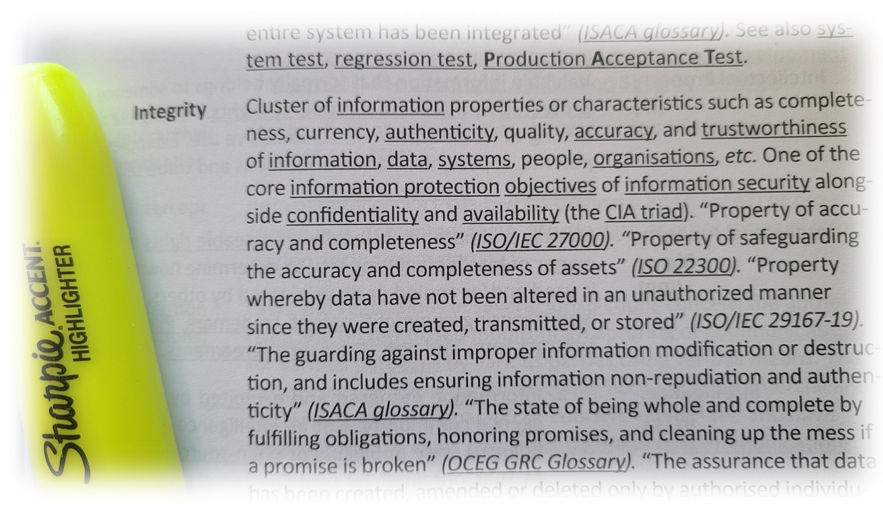
Quoted definitions from standards and other references suggest yet more interpretations, perspectives and contexts to consider. Compare and contrast the definitions or visit the original sources for further insight. Critical thinking is encouraged by the differences, similarities and, in some cases, provocative language, discrepancies or errors.
Fundamental terms of art, by their very nature, occur more frequently than more advanced or obscure terms, constantly refreshing the core learning while also extending the reader's knowledge and catching their eyes with other related and unrelated topics.
As they wend their way through the book, readers can follow their particular interests, retrace their steps or explore other paths, stop to think ... or simply press ahead through the maze, enjoying the experience.
I'm mainsplaining, I know - and that's a neologism I should probably add.


Comments